What Makes Corporate Sensitivity Training Effective (or Ineffective)
Here’s the uncomfortable truth: most sensitivity training fails before it even starts.

The eye rolls begin when the calendar invite lands. Someone makes a joke about “HR mandated fun.” By the time the session starts, half your team is mentally checked out, and the other half is bracing for an hour of being told they’re doing everything wrong.
This isn’t your fault. And it’s not your team’s fault either.
The problem is that most sensitivity training was never designed to actually work. It was designed to check a box. And your team can smell that from a mile away.
But here’s the thing: when training is designed well, it works. And there’s real science to prove it. So the question isn’t whether your organization needs sensitivity training. It’s whether you’re investing in the kind that actually changes anything.
The Mistake Most Training Providers Make: Theory Without Reality
Attend most sensitivity training sessions and here's what you'll get:
• Academic definitions of microaggressions
• Generic scenarios that feel nothing like your actual workplace
• Passive lectures where participation means nodding along
• A vague mandate to "do better" with zero concrete tools
The result? People leave the session thinking "that was nice, I guess" and then proceed to behave exactly as they did before. Nothing changes. The investment goes nowhere. And next year, you're back at square one, wondering why these sessions never seem to stick.
The core issue is simple: if your training doesn't feel relatable, it won't be actionable.
What Makes Sensitivity Training Effective: Skill-Building Over Compliance
Effective sensitivity training doesn't lecture people about what not to do. It equips them with practical skills they can use immediately. Here's the difference:
1. Start with empowerment, not shame
Traditional training: "Don't say this. Don't do that. You're probably biased and don't even know it."
Effective training: "You already care about your colleagues. Here are tools to show up better for them, even in moments when you're unsure."
When people feel respected and capable, they're exponentially more open to learning. That's not soft, it's strategic.
Decades of research on Self-Determination Theory, one of the most well-established frameworks in workplace psychology, shows that people are most motivated to change when three core needs are met:
Autonomy (feeling like an agent of your own behavior, not a pawn of external pressure),
Competence (feeling capable and effective)
Relatedness (feeling meaningfully connected to others).
Evidence across 119 workplace studies shows that satisfying these needs leads to better performance, reduced burnout, greater organizational commitment, and lower turnover. Intervention studies at Fortune 500 companies have demonstrated that training designed around autonomy support, rather than top-down control, not only changes the behavior of the people trained, but positively impacts the motivation and performance of their teams as well. The lesson is clear: respect people’s good intentions and give them practical tools, and they’ll do the work themselves.
2. Build psychological safety into the room
This is something we prioritize at CultureAlly, and we see it in the feedback every time. Participants consistently describe our facilitators as “engaging,” “personable,” and “encouraging curiosity.” That language matters. It tells you people felt safe enough to be open, which is the prerequisite for any real learning.
One participant wrote: “The facilitator was great! Very engaging and knowledgeable.” Another said: “This was great—Makeda has a wonderful way of explaining things and encouraging curiosity.”
The research on psychological safety explains why this matters so much. Google’s Project Aristotle studied 180 teams and found that psychological safety was the number one predictor of team success, above talent, resources, or structure. Workplace research from Gallup found that high psychological safety correlates with 12% more productivity and 27% less turnover. The APA’s 2024 Work in America survey reinforced this: workers who experience higher psychological safety are significantly more likely to report that their employers offer meaningful opportunities for feedback, involvement in decision-making, and inclusive connection with colleagues.
When your training session itself models psychological safety—when the facilitator creates a space where people can ask real questions without judgment—you’re not just teaching a concept. You’re letting people experience it. That’s what makes the learning effective.
3. Make it interactive, even virtually
Even in virtual sessions, you can create space for reflection, real-time questions, and peer-to-peer dialogue. Tools like live polling (we use Slido) turn passive listeners into activie participants. People share annonymously, which means they share honestly. And that’s when breakthroughs happen.
The principle is straightfoward: people learn more when they’re actively involved than when they’re passively listening. Our own feedback confirms it: participants consistently highlight the interactive elements as what made the session valuable, and satisfaction rates across our clients regularly land above 90%.
4. Focus on skills, not scolding
After one of our training sessions with a construction company, one participant said they wanted to learn more about “ethnic diversity.” Another wanted to explore “how to handle uncomfortable and inappropriate power dynamics.” These aren’t people tuning out. They’re people leaning in, because the training gave them a foundation they want to build on.
Effective training teaches:
How to recognize unconscious bias without shame
How to respond (not react) when someone says something problematic
How to navigate conflict with empathy and clarity
How to build psychological safety on your team
These are transferable, usable skills. Not theoretical concepts people forget by the next morning.
The Proof: What Happens When Corporate Sensitivity Training is Done Right
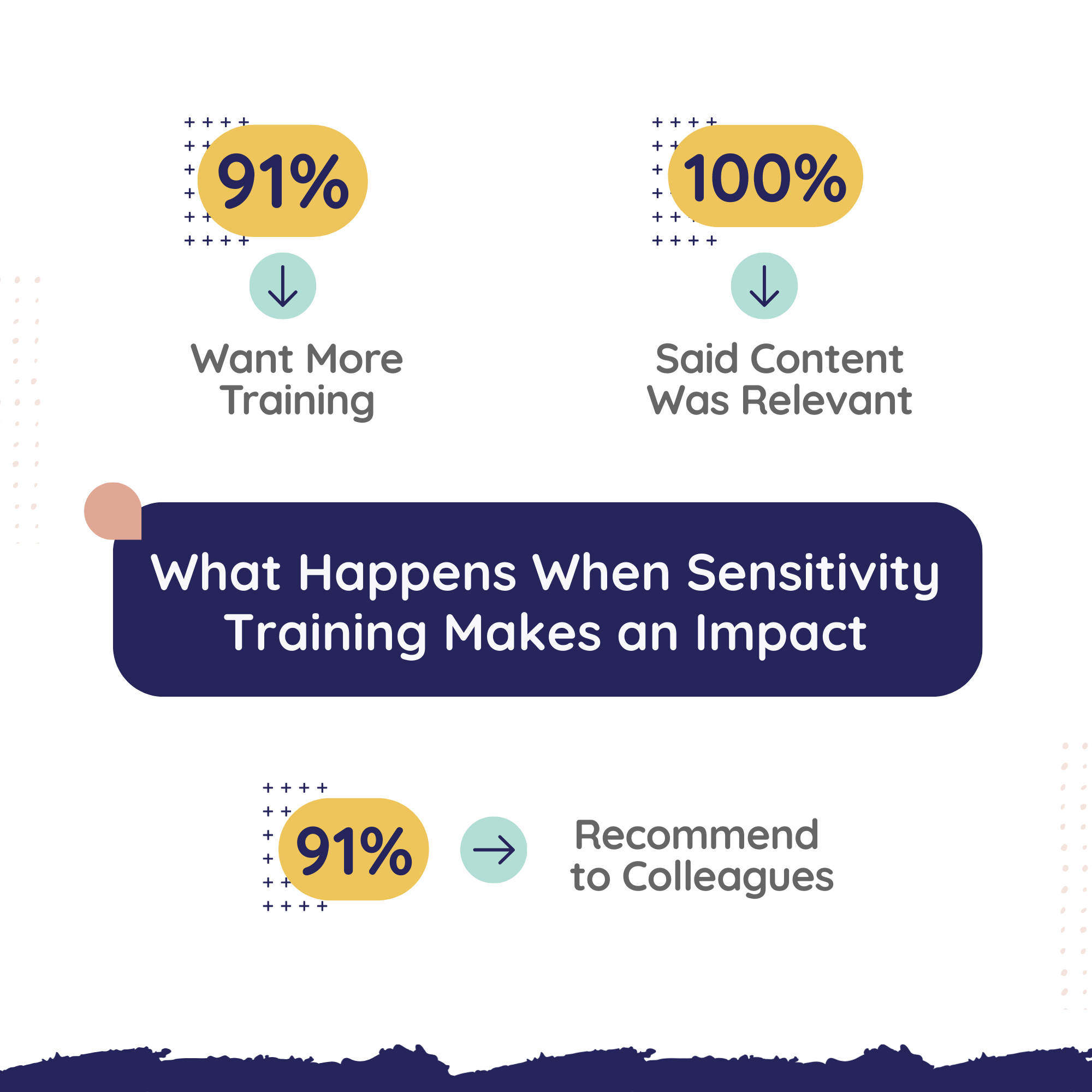
We don’t just believe this approach works, we measure it. Across industries, our participants consistently report high engagement and a desire for more:
At a national ice cream chain: 91% of participants said they’d recommend the training to colleagues. Feedback highlighted the interactive elements and practical strategies.
At a healthcare organization: 100% of respondents said the training was relevant and met their expectations. Participants requested follow-up sessions on inclusivity, empathy toward colleagues, and mental health.
At a university: 100% would recommend the session to colleagues. One participant noted it was their second training and the facilitator “continues to impress.”
The pattern is clear: people aren’t just tolerating these sessions. They’re engaged, they’re asking for more, and they’re leaving with skills they can use immediately.
How to Choose Sensitivity Training That Works
If you're responsible for bringing sensitivity training to your team, here's what to look for:
1. Look for facilitators who create psychological safety
Look at feedback from past sessions. Do people describe the facilitator as "engaging," "personable," or "encouraging curiosity"? Or do they say nothing at all (which often means the session was forgettable)?
The best facilitators don't talk at people, they create space for reflection, questions, and honest dialogue.
2. Insist on interaction, not lectures
Ask prospective providers: "How will participants engage with the material?" If the answer is vague or boils down to "they'll listen," keep looking.
Effective sessions include live polls, small group discussions, reflection prompts, or Q&A time. The format matters less than the principle: people learn by doing, not by passively receiving.
3. Measure what matters
Completion rates don't tell you much. What you want to know:
• Would participants recommend this to colleagues?
• Do they leave with specific, usable skills?
• Are they asking for more (not because it's mandatory, but because they found it valuable)?
If the answer to these questions is yes, you've found training that works.
4. Don't stop at one session
One healthcare organization saw such strong results that 95% of participants said they'd like access to more workplace training. At the construction company, that number was 43%, still nearly half the team.
Culture change doesn’t happen in 60 minutes. But a single effective session can build momentum for ongoing learning. A 2025 study from UC Irvine found that a 12-month sensitivity training curriculum built around interactive seminars and roundtable discussions was significantly more effective at equipping participants with lasting tools for culturally effective care than standalone sessions. And a 2024 systematic review from Boston University reached the same conclusion: the most impactful programs shift from one-time training to continuous, long-term learning that supports real behavioral and organizational change.
The key is making sure that first session doesn’t squander people’s trust.
The Bottom Line on Sensitivity Training
Your team doesn't groan at sensitivity training because they don't care. They groan because they've sat through too many sessions that wasted their time.
The good news? When training is interactive, relatable, and focused on building skills rather than assigning blame, people show up. They engage. They leave wanting more.
And that's when real culture change becomes possible.
Want to see what this looks like in practice? Learn more about CultureAlly's approach to sensitivity training and why organizations from ice cream shops to universities see 90%+ satisfaction rates.