What Is Workplace Communication Training? (And Why Your Team Needs It)
A project manager sends what she thinks is a clear, concise email: “Please finalize the deck by EOD.” One person interprets that as 5pm. Another reads it as midnight. A third assumes “finalize” means “review and flag issues” rather than “make presentation-ready.” By the next morning, three people did three different things and the client meeting starts in an hour.
Sound familiar? This isn’t a story about bad employees or managers. It’s about a team that was never given a shared language for how to communicate clearly. And they’re far from alone. According to Grammarly’s 2024 State of Business Communication report, 100% of knowledge workers surveyed say they experience miscommunication at work at least once a week. Not most, but all of them.
Workplace communication training exists to close that gap. Not by telling people to “communicate better”, but by teaching them how.

What Is Workplace Communication Training?
Workplace communication training is structured, skills-based learning that helps employees and managers communicate with more clarity, empathy, and intention. It covers the full spectrum of how people interact at work: the emails they write, the meetings they lead, the feedback they give, and the difficult conversations they either have or avoid.
Think of it this way: most professionals spend nearly 88% of their workweek communicating, whether writing, talking, meeting and messaging. But very few have ever received formal training in how to do it well. We train people on software, compliance and product knowledge. But the skill they use more than any other? We just assume they’ll figure it out.
That assumption is expensive.
Good workplace communication training involves practice. Participants go through real scenarios, get feedback, and leave with frameworks they can apply right away. The goal isn’t awareness, it’s behavior change.
The topics typically covered include verbal communication (word choice, tone, phrasing), nonverbal communication (body language, facial expressions, how your posture reads on a Zoom call), active and focused listening, written communication, email etiquette, choosing the right channel for the right messaging and giving and receiving feedback without triggering defensiveness.
The Cost of “Good Enough” Communication
Let’s talk numbers because this is where the conversation shifts from “nice to have” to “we can’t afford not to.”
Grammarly’s research found that miscommunication costs U.S. businesses an estimated $1.2 trillion annually. On a smaller scale, that works out to roughly $12,500 per employee per year in lost productivity, rework and missed handoffs. For a 200-person company, that’s $2.5 million in just communication breakdowns.
But the cost isn’t only financial. It’s cultural:
86% of employees and executives attribute workplace failures to a lack of effective communication
43% of employees have experienced burnout, stress, or fatigue due to workplace communication issues (Project.co, 2025)
50% of workers say ineffective communication directly impacts their job satisfaction
1 in 5 business leaders report losing business deals directly because of poor communication (Grammarly, 2024)
Workplaces with strong communication enjoy 4.5x higher employee retention
Poor communication doesn’t stay internal. It leaks into client interactions, customer experiences, and your organization’s reputation. When your team can’t communicate clearly with each other, they can’t communicate clearly with anyone.
5 Signs Your Team Needs Workplace Communication Training
Most leaders don’t realize communication is the root problem until they’re deep into symptoms that look like something else. If any of these sound familiar, it’s probably not a personnel issue; it’s a skills gap.
1. The same conversations keep happening
If your team rehashes the same topics in meeting after meeting, it usually means expectations weren’t clear the first time. People walk away thinking they’re aligned, but they’re each operating on a different understanding of what was decided, who’s responsible, and what “done” looks like.
2. Small misunderstandings escalate quickly
A question gets interpreted as a criticism. A short email reads as dismissive. Someone’s silence in a meeting gets mistaken for disengagement. When people lack the tools to communicate intent clearly or to check their assumptions before reacting, small friction turns into real conflict. (If this is already happening on your team, our guide to conflict resolution in management offers a deeper look at how to address it.)
3. People default to the wrong channel
Critical feedback delivered over Slack. A two-sentence question that became a 45-minute meeting. A long email chain that should have been a five-minute phone call. When people haven’t been taught to think critically about channel selection, they default to what’s comfortable, not what’s effective.
4. Feedback doesn’t land (or doesn’t happen at all)
In many organizations, the bigger problem isn’t that feedback is delivered poorly, it’s that it isn’t delivered at all. Managers avoid tough conversations because they don’t have a framework for how to have them without making things worse. Employees sit on frustrations until they either disengage or leave.
5. Engagement scores are slipping and no one can pinpoint why
Gallup's research consistently links engagement to communication. When employees don't feel heard, don't understand expectations, or aren't getting useful feedback, they disengage. And globally, only 21% of employees are engaged at work, down from 23% the year before. That two-point drop cost the global economy an estimated $438 billion in lost productivity.
What Good Workplace Communication Training Looks Like
If your only experience with communication training was a forgettable webinar or a compliance checkbox, you’re not alone. A lot of what passes for “communication training” is really just a presentation about why communication matters, followed by zero practice.
Effective training is different. It’s built around doing, not just knowing. Here’s what the best programs cover:
Self-awareness and communication styles
Everyone communicates differently. Some people are direct and task-focused: they want the bottom line, fast. Others are relationship-oriented: they need context, warmth, and connection before diving into the details. Neither style is wrong. But when a direct communicator sends a two-word Slack reply to a relationship-oriented colleague, it can feel dismissive even if it was meant to be efficient.
Great training helps people recognize their own default style and understand how it lands with others. That awareness alone can defuse a significant amount of everyday tension.
Active and focused listening
Listening sounds simple, but real active listening is a discipline. It means giving your full attention (not half-listening while scanning Slack), reflecting back what you heard to confirm understanding, asking clarifying questions instead of making assumptions, and holding space for the other person to finish before you respond.
In practice, it sounds like: “What I’m hearing is that the timeline shifted because of the vendor delay. Is that right, or is something else going on?” That simple check-in prevents the kind of misalignment that derails projects.
Choosing the right channel
This is one of the most practical and most overlooked skills in a workplace. A quick rule of thumb that effective training teaches:
Email: Non-urgent updates, documentation, anything that needs a paper trail
Chat/Slack: Quick questions, brief clarifications, informal coordination
Phone or video call: Anything where tone matters like nuanced discussions, feedback, sensitive topics
In person: High-stakes conversations, relationship-building, complex problem-solving
When your team has a shared understanding of which channel fits which situation, you eliminate a huge category of miscommunication — the kind that happens not because of what was said, but because of where it was said.
Delivering messages with clarity and empathy
This is where the rubber meets the road. Clarity without empathy comes across as cold or demanding. Empathy without clarity leaves people confused about what’s actually being asked.
Consider the difference between: “You didn’t include the Q3 numbers” and “I noticed the Q3 numbers weren’t in the report. Do you need anything from me to pull those together?”
Same issue. Completely different impact. The second version addresses the gap without assigning blame, and it opens a door instead of shutting one. These micro-adjustments in language compound over time. Teams that practice them develop a fundamentally different dynamic, one built on trust instead of tension.
Three Frameworks Your Team Can Start Using This Week
One of the biggest advantages of structured communication training is that it gives people shared tools, not just general advice. Here are three frameworks that show up in the best programs and that any team can start applying immediately.
BLUF: Bottom Line Up Front
Borrowed from military communication, BLUF is simple: put your main point or request at the top of the message, not at the bottom. Why? Because most people scan emails and messages. If your key ask is buried in paragraph three, there’s a real chance it never gets seen.
When teams learn to lead with the action item, and follow with context, the back and forth of “wait, what do you actually need from me?” drops dramatically. It’s a small shift in structure that changes how quickly people can respond and move forward.
The 3 Cs: Clear, Concise, Complete
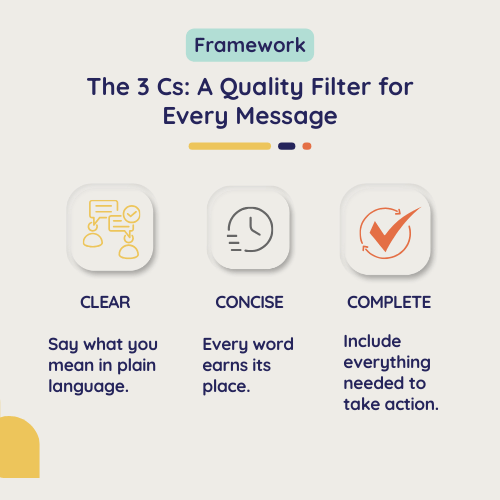
This is a quality filter for any message, whether it’s email, Slack, voicemail, even a meeting agenda:
Clear: Use plain language. If someone outside your department wouldn’t understand it, simplify.
Concise: Respect the reader’s time. Every sentence should earn its place.
Complete: Include everything the other person needs to take action. Deadlines, context, who’s responsible, so there’s no follow-up email asking “wait, when is this due?”
The 3 Cs sound basic, but applying them consistently is harder than it seems. How often do you read an email and realize you don’t know what’s actually being asked? Or get a Slack message with zero context? These are 3 Cs failures. When a team starts using this as a shared standard, the quality of everyday communication shifts noticeably.
Nonviolent Communication (NVC)
Developed by psychologist Marshall Rosenberg, NVC is a four-step framework that’s especially useful for feedback, difficult conversations, and any situation where emotions are running high:
Observation — Describe what happened factually, without judgment or interpretation.
Feeling — Name your professional impact or emotional response.
Need — Explain the underlying need that isn’t being met.
Request — Make a specific, actionable ask.
NVC works because it separates the person from the problem. It gives people a way to address what’s not working without blame, which means the other person can actually hear the feedback instead of getting defensive. (For a deeper dive into this framework, our NVC guide breaks it down with more workplace examples.)
What Separates Impactful Training From Training People Forget
You’ve probably sat through training that felt like a waste of time. So have your employees. The difference between a forgettable session and one that actually changes behavior usually comes down to a few things:
It’s interactive, not passive. Research published in the Proceedings of the Academy of Sciences found that people learn significantly more through active participation than through lectures. And according to the National Training Laboratories, retention rates jump from as low as 5% in lecture-based learning to up to 75% when people learn by doing. The takeaway: your team learns communication by practice, scenarios, real-time polling, and peer dialogue.
It uses real scenarios, not generic ones. The best training sessions pull from situations your team actually faces. An email misunderstanding between a project lead and a remote teammate. A feedback conversation with a direct report who’s underperforming. A cross-departmental handoff that keeps breaking down. When the scenarios feel real, the skills transfer.
It’s facilitated by someone who can read the room. An experienced facilitator adjusts in real time. They notice when the room gets tense and create space for it. They make it safe to practice something new and get it wrong. That’s hard to replicate with a self-paced module alone.
It’s part of a bigger commitment, not a one-and-done. Research on training transfer consistently shows that one-time sessions, no matter how good, fade without reinforcement. The first session builds the foundation. What you do after, reinforcing the frameworks in team meetings, building them into performance conversations, giving people ongoing access to resources ,determines whether the skills actually stick.
It empowers, never shames. This is critical. If people feel judged or called out, they shut down. The goal isn’t to tell anyone they’ve been communicating wrong. It’s to give them better tools for doing something they already care about doing well.
The Communication Pitfalls Hiding in Plain Sight
One of the most valuable outcomes of communication training is that it names the patterns your team falls into without realizing it. These aren’t character flaws — they’re habits. And they’re far more common under stress, tight deadlines, or when teams are spread across locations and time zones.
The most frequent ones:
The assumption trap: Assuming everyone has the same context you do. (“I thought you knew the deadline moved.”)
Jargon overload: Using acronyms or internal shorthand that new team members, cross-functional partners, or clients don’t recognize.
The Goldilocks problem: Over-communicating (burying the point in too much detail) or under-communicating (leaving out the information people need to take action).
Skipping the close: Ending a conversation or meeting without confirming who owns the next step, what the deadline is, and what “done” looks like.
Channel mismatch: Delivering sensitive feedback over email. Scheduling a meeting for a yes/no question. Sending a wall of text on Slack when a two-minute call would have resolved it.
These patterns show up everywhere, in hospitals, corporate offices, government agencies, construction teams, nonprofits. The common thread isn’t industry or role. It’s that most people were never taught to spot these habits in themselves. Once they can see them, they can change them.
Where to Start
You don’t need to overhaul your team’s entire communication culture overnight. But you do need to start somewhere. Here’s a practical timeline:
This week: Try the BLUF method in your next team email. Lead with the main point and a clear request. Notice how people respond.
This month: Ask your team: “What’s one communication habit that slows us down?” Their answers will tell you where the real friction is, and it’s almost never where leaders assume.
This quarter: Invest in a structured communication training session. Not a lecture. Not a webinar people half-watch on mute. A live, facilitated, skill-building experience where your team practices the frameworks together.
Communication Is a Skill And Skills Can Be Trained
The organizations that communicate well don’t just avoid problems. They move faster. They build more trust. They retain better talent. And they create workplaces where people feel confident enough to speak up, push back constructively, and do their best work.
Your team already has the talent and the intention. What they may be missing are the tools.
Workplace communication training closes that gap. And when it’s done well — interactive, practical, grounded in real scenarios — the shift is something you can feel in the room before the session is even over.
CultureAlly’s workplace communication training is live, expert-facilitated, and built around the skills and frameworks covered in this post. If you’re exploring options for your team, we’d love to start the conversation.