Customer Service Training: What It Is, What It Covers, and How to Know If It's Working
Your team knows the policies. They’ve been through onboarding. They can recite the return policy in their sleep. And yet, complaints keep coming in. Interactions go sideways. Customers leave frustrated, and your staff leave exhausted. Sound familiar?
The problem usually isn’t knowledge, it’s skills. Customer service training builds the skills most organizations assume their team already have: empathy, active listening, adaptability, de-escalation, and the cultural awareness to serve people well regardless of who they are or how they communicate.
This post breaks down what those skills are, why they matter, and what good training really looks like, so you can make an informed decision about what your team needs.

What Is Customer Service Training?
Customer service training teaches employees how to communicate professionally, handle difficult interactions with composure, and consistently represent your organization well, whether they’re dealing with customers, clients, patients, or the public. It goes beyond scripts and policies to build the underlying skills that make those interactions work: empathy, active listening, adaptability, de-escalation, and cultural awareness.
Done well, it’s not a one-time compliance check. It’s a skill-building investment that shapes how your people show up for customers and for each other.
Customer Service Is a Workplace Culture Problem
According to a Salesforce State of the Connected Customer report, 88% of customers say the experience a company provides is as important as its product or service. That means your team’s communication skills, composure under pressure, and ability to make people feel heard are just as critical as what you’re selling. And yet most organizations invest heavily in product knowledge and less on people skills that shape every customer interaction.
But here's what the data also shows: Gallup research has found that only 31% of U.S. employees are engaged at work. Disengaged employees don't deliver great service. They don't go the extra mile, handling complaints by the book, without warmth. And customers feel it.
This isn't a scripting problem. It's not solved by teaching people to say "I understand your frustration." It's a culture problem and it requires a cultural solution. When people feel respected, heard, and psychologically safe at work, they extend that same energy outward. When they don't, they can't fake it for long.
First Impressions: The 7-Second Rule Isn't a Myth
Research from Princeton University found that people form judgments about competence, trustworthiness, and likeability within a fraction of a second. And those judgments are remarkably hard to reverse. In a customer service context, that means the first greeting, the first email response, the first time someone answers the phone shapes the entire arc of the relationship.
What does a strong first impression look like in practice?
A warm, professional greeting, not a scripted one. Customers can tell the difference.
Attentive body language or vocal tone, making eye contact, or speaking with calm confidence.
A helpful mindset from the start, not "what do you need?" but "I'm here to help you figure this out."
These are trainable behaviors and organizations that treat them as such see measurable results.
Empathy and Active Listening: The Skills Teams Need Most and Get Least
Ask any manager what skills their team needs to handle difficult customers, and they'll say empathy. Ask them how they're training for it, and you'll usually get a pause.
Empathy isn't something you either have or you don't. Like any skill, it gets stronger the more you use it. Active listening training is one of the most direct ways to build it.
In service contexts, empathy and active listening work together:
Active listening goes beyond waiting for your turn to speak; it means listening fully, confirming understanding, and then responding.
Empathy in action sounds like: "I can hear how important this is to you. Let me make sure I understand what you need before we figure out the next steps."
Patience under pressure means staying composed when a customer is frustrated, direct, or emotional without taking it personally.
Emotional regulation is the ability to manage your own reactions so that you can respond thoughtfully. The American Psychological Association has documented that it is one of the most significant predictors of workplace performance. This is exactly what active listening training builds.
Assumptions: The Hidden Barrier to Great Service
Here's something uncomfortable: your employees are making assumptions about customers in every single interaction. We all do it. The brain takes cognitive shortcuts to process information quickly. The problem is when those shortcuts become filters that distort what we're actually hearing.
Common assumptions in service interactions include:
"This customer should already know how this works."
"They're being rude on purpose."
"This person is just trying to get something for free."
"Their communication style means they're aggressive."
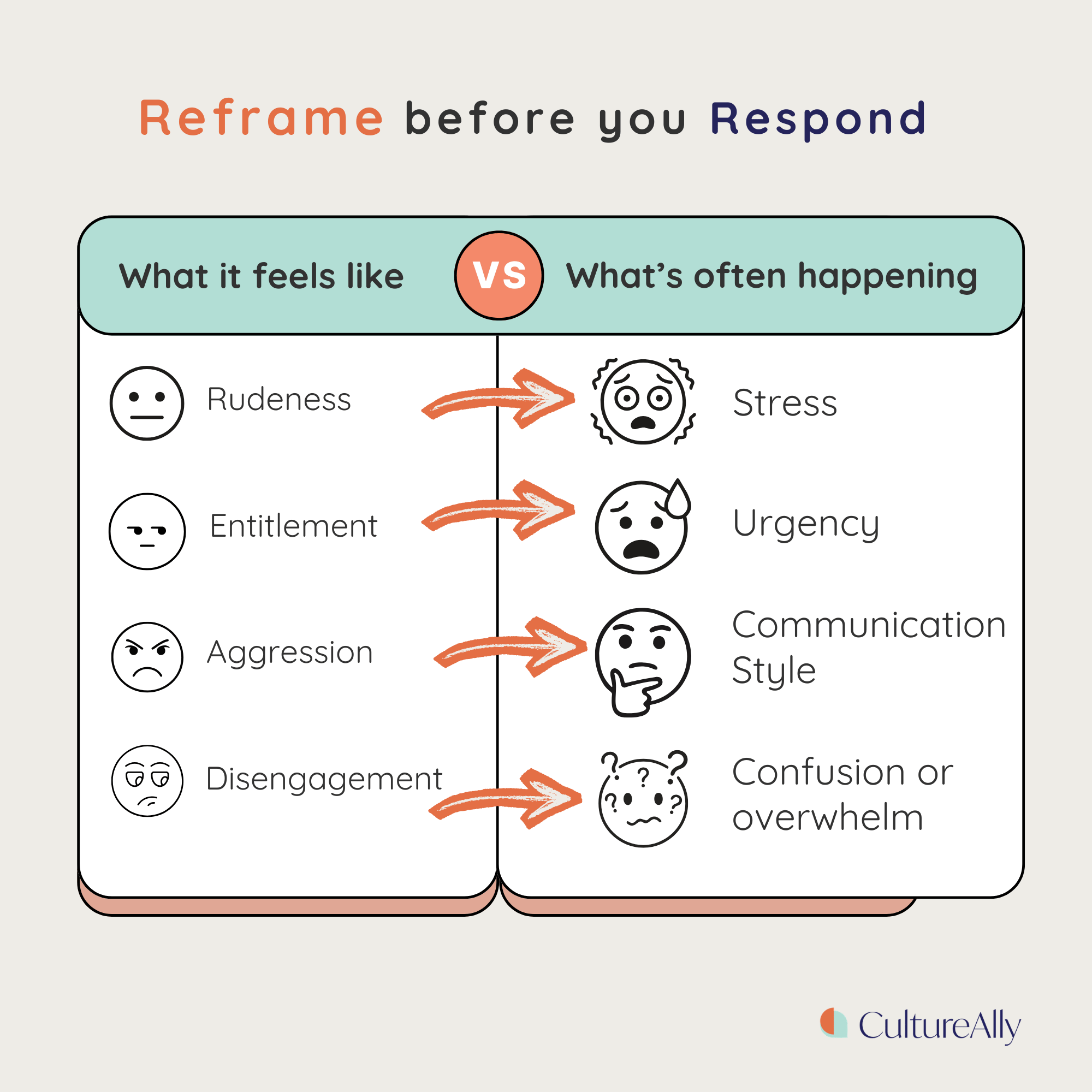
What's really happening? Often, what reads as rudeness is stress. What reads as entitlement is urgency. What reads as aggression is a cultural communication norm that's different from our own.
This is where cultural competence and customer service intersect. Customers come from varied backgrounds, with different life experiences and communication styles. Recognizing your assumptions isn't about being politically correct, it's about serving people effectively. When you assume less, you listen more. When you listen more, you solve problems faster.
Adaptability: One Size Does Not Fit All Customers
The best service professionals don't treat every customer the same. They read the room.
A frustrated customer needs you to slow down, repeat information clearly, and lead with empathy before solutions.
An impatient customer needs you to get to the point quickly while still remaining respectful.
A confused customer needs plain language, no jargon, and a clear next step.
This is adaptability and it's one of the most underrated skills in service environments. Think about the last time you had a frustrating customer interaction. Chances are the problem wasn't that the issue went unresolved, it's that the person handling it made you feel like a number. How something is delivered matters as much as what gets delivered.
The key to adaptability without inconsistency? Hold the standard constant (treat everyone with respect, follow policy, communicate professionally) while flexing your style to meet people where they are.
De-Escalation: The Skill That Protects Your People and Your Reputation
De-escalation gets treated like a reactive, crisis-level skill. It's not, or it shouldn't be. De-escalation is a daily practice. And it starts not with the customer, but with the person serving them.
When an employee hasn't learned to notice and regulate their own emotional reactions, a tense interaction becomes a spiral. The customer gets more frustrated. The employee gets more defensive. The situation escalates and no one wins.
The core de-escalation skills that work:
Self-regulation first. Notice your own reaction before responding. A two-second pause changes the energy of an interaction.
Validate emotion, not behavior. "I understand this is frustrating" is different from agreeing that the customer's behavior is acceptable. You can hold both at once.
Shift from debate to dialogue. Stop trying to win the interaction. Start trying to solve the problem together.
Know when to ask for help. If a situation feels unsafe, emotionally overwhelming, or stalled, escalating to a manager isn't failure — it's professionalism.
According to the APA, chronic exposure to difficult interactions without adequate coping skills is a significant driver of workplace stress and burnout — particularly in service-heavy industries like healthcare, hospitality, and retail. Training your team in de-escalation isn't just good for customers. It protects your people.
Why Training Alone Isn't Enough (and What to Do About It)
Most customer service training fails for one reason: it teaches the script without building the skills. Employees learn what to say without learning how to think in real, messy, high-pressure situations.
Effective training, the kind that changes behavior, does three things:
Creates space for reflection. Not just practice, but self-examination. Asking "What assumption am I making right now?" in a safe learning environment builds the habit of asking it in real time.
Uses real scenarios. Generic case studies don't land. Scenarios that mirror your team's actual interactions, like the the irate patient in a hospital or the confused customer at a front desk, do.
Builds psychological safety in the room. If employees don't feel safe practicing or being honest about their struggles during training, the skills won't transfer. The learning environment has to model what you're asking them to do.
This is the approach CultureAlly takes across all of our Essential Workplace Training programs, including our Customer Service training session. And we use tools like live polling and peer dialogue to make the learning interactive, not passive.
The Bottom Line
Customer service etiquette is the front line of your brand, your culture, and your employee wellbeing strategy all at once. When your people know how to communicate clearly, adapt thoughtfully, manage their own reactions, and handle pressure with professionalism everyone wins. Customers stay loyal. Employees stay longer. And your organization builds the kind of reputation that no marketing budget can buy.
The question isn't whether these skills matter. It's whether you're investing in building them, or hoping they show up on their own.
Frequently Asked Questions
How long is customer service training?
It depends on the format and your goals. A focused workshop typically runs 60–90 minutes and covers the core skills: communication, empathy, active listening, and handling difficult situations. More in-depth programs — especially those that include cultural competence, de-escalation, and scenario practice — may be delivered across multiple sessions. At CultureAlly, our standard session runs 60 minutes virtually, but we can help you build a learning and development series or customize the program entirely around your team's needs.
Who should attend customer service training?
Anyone who interacts with customers, clients, or the public but also anyone who works across teams internally. The skills covered in customer service training (clear communication, empathy, managing conflict, reading the room) are the same skills that make managers better leaders and colleagues better collaborators.
What’s the difference between customer service training and sensitivity training?
They overlap more than most people expect. Customer service training focuses on professional communication, etiquette, and handling interactions well. Sensitivity training focuses on awareness of bias, cultural differences, and how assumptions affect behavior. In practice, the best customer service training incorporates both because assumptions about customers directly affect service quality, and cultural awareness makes teams more adaptable and effective. CultureAlly’s programs are designed with that integration in mind.
How do you measure whether customer service training is working?
Look beyond post-training satisfaction scores. The metrics that actually matter: customer satisfaction and complaint rates before and after, employee confidence self-assessments, manager observations of communication in real interactions, and turnover in customer-facing roles. Effective training shows up in behavior, not just survey responses. We recommend building in a 60–90 day follow-up touchpoint to assess what’s transferred and where teams need reinforcement.