Does Your Team Need Training, Coaching, or Consulting? Here's How to Choose
Does your team need training, coaching, or consulting? It sounds like it should have a simple answer. It doesn't. And that gap between the question and the answer is costing organizations real money.

Here's what actually happens: a lot of organizations buy the wrong thing. Not because they don't care. It's because the market makes it genuinely hard to tell the difference between what you need and what a provider is selling. Training programs that promise culture change in a 90-minute session. Coaches who hand over a framework and call it transformation. Consultants who deliver a polished deck, then disappear. The interventions are real. The intentions are often good. But when the wrong solution gets applied to the right problem, nothing changes and the budget takes the blame.
If you're an HR leader trying to work out what your organization actually needs right now, this post will help you think it through. We'll give you an honest framework for deciding, and show you what each approach delivers when it's done right.
What You'll Learn
The real difference between workplace training, executive coaching, and culture consulting and why it matters for outcomes
How to match the right intervention to your specific situation and goals
What to consider about delivery format: virtual, in-person, and eLearning
A practical decision framework HR leaders can use to choose between training, coaching, and consulting
How to sequence these investments for compounding culture impact
How to measure ROI for each approach when leadership asks
Training vs. Coaching vs. Consulting: Why the Wrong Choice Costs More Than You Think
The most common mistake isn't choosing bad training, bad coaching, or bad consulting. It's choosing the right thing for the wrong problem.
Training a whole team on communication skills won't fix the one leader who refuses to model them. Coaching that leader won't address the systemic dynamics that shaped the team around them. And a consulting engagement that produces a strategy deck won't move anything if the people responsible for implementing it don't have the skills or the buy-in to act.
There's also a market problem worth naming. The workplace culture space has no shortage of providers who will sell you whatever you're asking for, even when it isn't what you need. A training company will find a way to make your problem look like a training gap. A coaching firm will position everything as a leadership issue. The organizations that spend years spinning their wheels on culture aren't always doing the wrong things. They're often doing good things in the wrong sequence, or with providers who weren't honest about the limitations of their own offering.
These three approaches, training, coaching, and consulting, aren't competing. They're complementary. The organizations that see real, lasting culture change tend to use all three. The key is knowing which one to reach for first.
What Is Workplace Training? When Should You Choose It?
Training builds skills across a group. It's designed to shift how people communicate, respond to conflict, practice inclusion, or collaborate at scale. Done right, it creates shared language, shared expectations, and behavior change that ripples across a team..
The operative phrase is “done right.” Because a lot of workplace training isn’t. It’s a 60-minute video. A compliance module nobody asked for. A slide deck delivered to a room of people who can tell it was built for someone else’s organization.
That kind of training doesn’t fail because training doesn’t work. It fails because it was never really training. It was a box someone needed to check.
Training is the right investment when:
You have a skill gap that affects multiple people (e.g., conflict de-escalation, inclusive communication, psychological safety)
You're responding to a culture moment, such as an observance, a policy change, a team reset
You need scalable, cost-effective development across a large or distributed workforce
You want to build shared language and norms before a bigger culture initiative
Training is less effective when:
There's no leadership buy-in. When managers don't model or reinforce what was covered, the learning evaporates quickly.
There's no reinforcement afterward. A single session won't change behavior on its own. Training works best as part of a longer arc, not a one-time event.
The real issue is individual leadership behavior. If one person is the source of a team's dysfunction, training the whole team around them is a workaround, not a fix.
On delivery format: Virtual training has matured significantly. For most skill-building topics (conflict resolution, inclusive communication, civility), it works extremely well when it's facilitated live with real-time tools like polling, reflection prompts, and structured peer dialogue. The key word is live. A Zoom webinar where people sit with cameras off isn't the same thing.
In-person training creates more connection and is often preferred for emotionally complex topics or team resets where trust needs to be rebuilt in the room.
On-demand eLearning works well for foundational learning and reinforcement.
What Is Executive Coaching? When Should You Choose It?
Coaching works on the person, not the room. It's a sustained relationship between a leader and a coach, built around one question: how does this person actually show up, and what gets in the way of them showing up better?
That sounds straightforward. In practice it's some of the hardest professional work a leader will do, because it requires them to look honestly at habits and patterns they've often built an entire career around. The leaders who get the most from coaching aren't necessarily the most polished. They're the ones who came in genuinely willing to be wrong about themselves.
Coaching has also become a catch-all, and that's worth naming. It gets used as a response to performance issues that should be handled differently, handed out as a reward to executives who didn't ask for it, and applied to problems that are really about team dynamics or organizational structure rather than individual behavior. Real coaching, the kind that actually shifts how someone leads, takes months, requires genuine willingness, and depends on whether the coach can hold the work to a real standard.
Coaching is the right investment when:
A leader is technically strong but struggling with influence, communication, or team dynamics
You're preparing someone for a new role or expanded responsibility
An executive needs to navigate a complex culture challenge like restructuring, conflict, or change leadership
Training alone hasn't moved the needle on a leadership behavior pattern
You're investing in high-potential talent retention
Coaching is less effective when:
The leader isn't genuinely open to it, coaching requires willingness, not just compliance
You're expecting quick, broad culture change, coaching takes months and its impact is individual first
The challenge is structural or systemic, not personal
On delivery format: 1:1 coaching translates well to virtual delivery. Most of the real work happens in the conversation and between sessions. Work like reflection, journaling, and behavioral experiments. In-person sessions can be valuable for rapport-building early in a coaching relationship, but they aren't required. What matters most is consistency, trust, and a coach who has genuine expertise in leadership and workplace dynamics.
What Is Culture Consulting? When Should You Choose It?
Consulting diagnoses and shapes the system. Where training builds skills and coaching develops individuals, consulting works at the organizational level. It makes sense of what's actually happening across your culture, why it's happening, and what structural or strategic changes would move the needle.
Most organizations already have data, like engagement survey results, exit interview themes, manager effectiveness scores, retention numbers. What they often don’t have is someone to help them interpret what that data is actually telling them and build a strategy around it. That’s where consulting earns its place.
At its worst, it's a consultant who asks good questions, produces a polished report, and then hands it to you to figure out. The diagnosis was real. The recommendations were reasonable. But nothing changed, because implementation was never part of the deal. If you've experienced that, you're not alone and you're right to be skeptical. The question to ask any consulting partner is: what does support look like after we have the strategy? The answer tells you everything.
Consulting is the right investment when:
You have data but aren’t sure what it’s telling you or what to priortize first
You're building or refreshing a multi-year culture strategy
You're launching or restructuring ERGs and need frameworks, not just inspiration
Leadership is asking for a culture roadmap and you don't have the internal bandwidth to build it alone
Training has happened but hasn't produced sustainable change, the issue may be structural
Consulting is less effective when:
There's no leadership support for implementation. A strategy without accountability is a document. If your executive team won't act on findings, the consulting engagement becomes shelf content.
You've skipped diagnosis and gone straight to recommendations. Good consulting starts with listening. Providers who come in with solutions before they understand the problem are selling a product, not solving yours.
You need immediate, visible action. Consulting takes time to do right. If you're under pressure to show progress this quarter, start with training while the deeper diagnostic work runs in parallel.
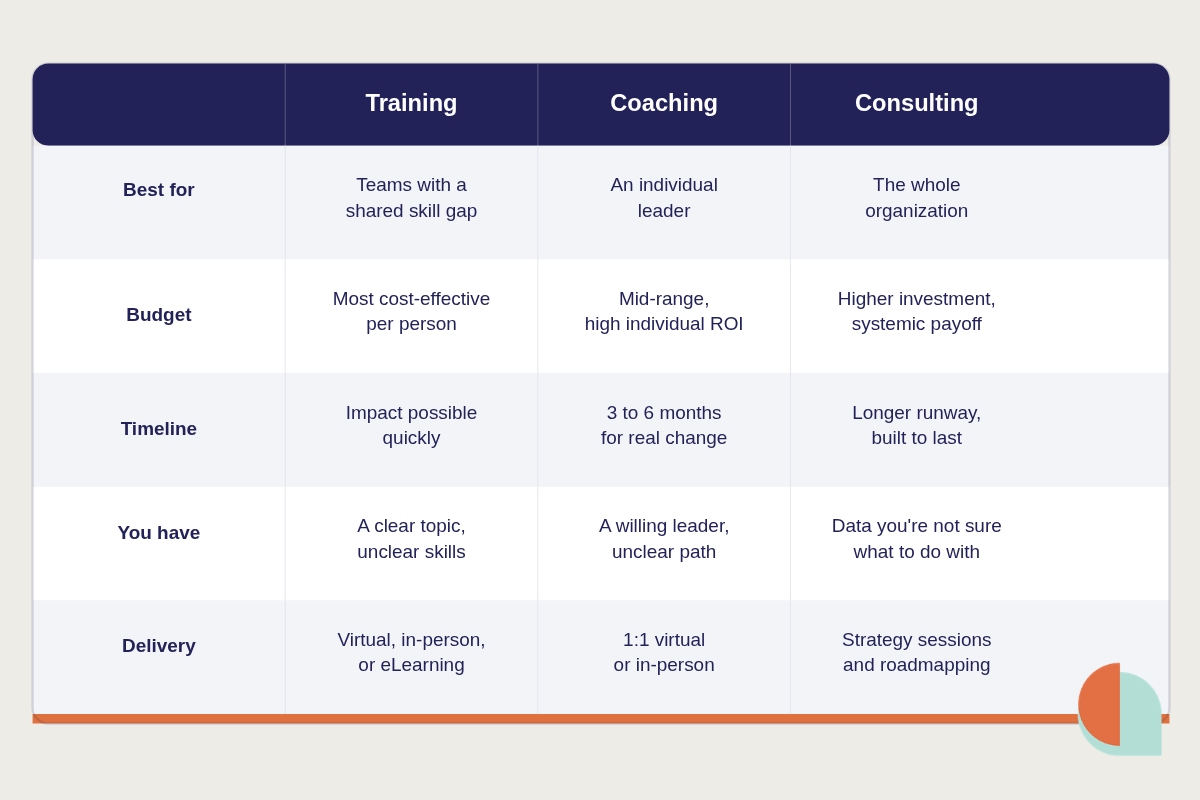
Training vs Coaching vs Consulting Decision Framework
Before the table below, try answering these three questions:
Who is the primary recipient of change? A group of employees → training. An individual leader → coaching. The organization as a whole → consulting.
What do you know and what are you assuming? If you're confident about the skill gap, training is ready. If you're unsure what's driving the problem, consult first.
What's your timeline? Training can create impact quickly. Coaching creates change over months. Consulting builds foundations that compound.
Why the Best Results Usually Involve All Three
Here's what we see repeatedly: organizations that try to solve a culture problem with a single intervention tend to plateau. The training lands, people feel energized, and then a month later the same dynamics are back. Or the coaching engagement produces a genuinely transformed leader, but the team around them never got the skills to meet them there.
The most sustainable change comes from sequencing these investments intentionally:
Start with consulting (or at minimum, a structured conversation about what your data is telling you) to understand where you actually are, not where you think you are.
Layer in training to build the skills your team needs to close the gaps the data revealed. This is where shared language forms, new habits start, and people begin to experience what the culture could actually feel like.
Add coaching for the leaders whose individual development will either accelerate or quietly undermine everything else. Culture is downstream of leadership. That's not a metaphor.
For organizations with tighter budgets or earlier-stage culture work, you don't have to do all three simultaneously. Start where the pain is highest. Get a real win, something that is measurable and visible. Then build from there. What matters is that you're sequencing with intention, not reacting to whatever crisis just landed in your inbox.
CultureAlly works with organizations at every stage of this journey, including those who are starting with a simple question: where do we even begin? That's such a valid place to start. We have a free tool for exactly that.
What About eLearning? Where Does It Fit?
On-demand eLearning isn't a replacement for live training, coaching, or consulting but it's an important part of a complete learning ecosystem. It works best when:
You need consistent onboarding content delivered to employees across locations and time zones
You want to reinforce live training between sessions
Your budget requires you to scale access without scaling facilitation costs linearly
Learners need to complete foundational content at their own pace before a live session
CultureAlly's ConnectED platform offers interactive, scenario-based modules with gamification, admin tracking, and certificates of completion with SCORM support for existing LMS integrations.
Thinking About Budget: What HR Leaders Need to Hear
Budget is always part of this conversation. Here's how to think about each investment honestly, including what to say when leadership pushes back:
Training: The broadest reach per dollar
A well-facilitated virtual training session can reach your entire team, department, or organization at once. For organizations with 50–500+ employees, a single expert-led workshop typically delivers better per-person ROI than almost any individual engagement. And custom training returns even more, because your team sees themselves in it.
The ROI conversation with your CFO starts here: Gallup's research found that 70% of the variance in team engagement is attributable to the manager. Training that improves how managers communicate, handle conflict, and retain their teams pays for itself in ways that are entirely quantifiable, you just have to connect the dots.
The caveat: cheap training is often the most expensive training. A session that produces no behavior change costs more than a well-designed facilitated program because you still have the original problem, plus the cynicism that comes from a team who sat through something that wasted their time.
Coaching: The highest per-person ROI for key leaders
Executive coaching feels like a significant investment because it's priced individually. But the ROI question isn't "is this expensive?" It's "what is this leader's multiplied impact on our culture, retention, and performance?" A manager who creates annual turnover on their team costs far more than a coaching engagement. A senior leader who consistently derails culture work from the top costs the entire initiative.
The data is clear: 86% of organizations that tracked coaching ROI reported positive returns with a median return of 5 to 7 times the cost of the engagement. When you frame it that way for your executive team or CFO, the investment decision looks different.
The coaching providers worth choosing are honest about what coaching can and can't do. It's not a replacement for accountability. It's not a performance management tool. It works when the leader is genuinely open and the coach has real expertise, not just a certification.
Consulting: The lowest cost of making wrong decisions
Consulting has the highest upfront cost and the longest time-to-visible-impact. It's also what prevents organizations from spending five years doing the right things in the wrong order. A good consulting partner helps you make sense of what your data is actually telling you. Engagement trends, turnover patterns, leadership feedback — once those pieces connect, every training and coaching decision that follows improves. That's not a soft benefit. That's risk mitigation with a very clear payoff.
Consider the scale of what's at stake: Gallup's 2024 State of the Global Workplace report found that only 21% of employees globally are engaged. This translates to an estimated $438 billion in lost productivity worldwide. Most of that loss isn't due to organizations not investing in culture. It's because they're investing without clarity on what's actually driving the problem. That's exactly what good consulting is designed to fix.
The organizations that skip the strategic clarity phase often discover, 2 or 3 years later, that they've been solving the wrong problem. The consulting investment looks expensive until you calculate what it costs to course-correct after years of misdiagnosis.
Frequently Asked Questions: Training, Coaching, and Consulting
What is the difference between training, coaching, and consulting?
Training builds skills across a group. It's delivered to teams and focuses on changing how people communicate, collaborate, or respond to specific situations. Coaching is a 1:1 development relationship focused on an individual leader's awareness, habits, and behavior change over time. Consulting works at the organizational level, diagnosing culture challenges, assessing data, and building strategy. All three can work together, but they address fundamentally different levels of change: individual skill, individual behavior, and systemic structure.
When should an organization choose training over coaching?
Choose training when the issue is a skill gap affecting multiple people. For example, a team that needs to handle conflict more effectively, communicate more inclusively, or build shared norms around respect and belonging. Training is also the right choice when you need scalable impact at a lower per-person cost. If the challenge is concentrated in one leader's behavior rather than a team-wide skill, coaching is likely the better fit.
When does executive coaching make more sense than team training?
Executive coaching is the right investment when a specific leader is the primary driver of a culture problem, when someone is being developed for a new or expanded role, or when a leader's behavior hasn't shifted despite group training. Coaching works at the individual level — it's personalized, ongoing, and designed to produce lasting behavior change. It typically takes three to six months to see meaningful results, so it requires a longer time horizon than a single training session.
What does a workplace culture consultant actually do?
A culture consultant helps organizations understand what's happening across their workforce through surveys, focus groups, interviews, and data analysis and then builds a strategy to address it. This might include an inclusive workplace strategy, ERG support, culture assessments, or communications guidance. The best consulting engagements don't stop at the diagnosis; they stay with the organization through implementation. The deliverable isn't just a report; it's clarity, direction, and the data to make better decisions.
Can you use training, coaching, and consulting at the same time?
Yes, and the best culture outcomes usually involve all three working together. A common sequencing: start with a culture assessment or consulting engagement to understand the actual gaps, layer in training to build team-wide skills, and add coaching for the leaders whose individual development will accelerate or block the broader effort. You don't need to do all three simultaneously. Start where the pain is highest, then build from there.
Is virtual training as effective as in-person training?
For most skill-building topics, virtual training works very well when it's delivered live with real interaction, not a webinar people half-watch while answering email. The key distinction is live facilitation versus passive delivery. A well-run virtual session outperforms a poorly designed in-person one. In-person training tends to be preferred for emotionally complex topics or team resets where physical presence helps rebuild trust.
What is eLearning and when should it be used for workplace training?
eLearning refers to on-demand, self-paced digital learning, like modules, videos, and interactive content employees complete on their own schedule. It works best as a complement to live training: reinforcing skills between sessions, onboarding new employees consistently across locations, and making learning accessible at scale without requiring live facilitation. eLearning is not a replacement for a live facilitated training experience, particularly for topics that require dialogue, nuance, and human interaction.
How do you measure the ROI of training, coaching, or consulting?
ROI looks different for each approach. Training ROI is often measured through engagement scores, manager effectiveness ratings, behavioral surveys, and retention data before and after. Coaching ROI is best tracked at the individual level: 360-degree feedback, leadership effectiveness scores, team engagement, and qualitative feedback from direct reports. Consulting ROI is the hardest to isolate but often the most significant. It's measured in the quality of decisions made downstream, reduction in reactive spending, and whether the culture strategy actually gets implemented and sustained.
The Bottom Line
Most problems don't stay problems because people aren't trying to fix them. They stay problems because the wrong thing keeps getting applied to them. Training a team that needs a better leader. Coaching a leader whose real constraint is a broken system. Building a strategy nobody has the skills to implement.
Training, coaching, and consulting each do something the others can't. The question was never which one is best. It's which one fits what's actually happening in your organization right now.
If you're not sure, that's worth figuring out before anything else. Everything you invest after that decision depends on it.